




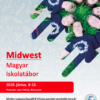
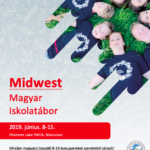
For the seventh time, a mother tongue camp is organized in Arad for primary school students who learn Hungarian language and literature as an optional.
The activities started in the “Csiky Gergely” gymnasium on Monday, the participants are students from the localities where there is no teaching in Hungarian, or there are only for 1st-4th grade classes. A week of vacation that students can spend time by learning and playing where they can extend their abilities in their mother tongue (Hungarian), learn specific terms, historical names, folk traditions and folk language. The camp is supported by DAHR in Arad, together with the Hungarian Teaching Staff Association in Romania, the activities are held by teachers.
“The camp was invented to encourage students, it is a kind of prize for Hungarian pupils with good performance in education. In the first camp there were 30 participants, and I remember that in the first few days the children spoke in Romanian in a pause between them. At the end of the camp, they already have known 40 popular songs, and everyone has spoken in Hungarian. “- said Prof. Matekovits Mihály, president of the Hungarian Teaching Staff Association.
At the moment, students from 5th-8th grade classes, who use Hungarian only in the family and eventually in society, participate in the camp, but at school they study in Romanian and Hungarian language and literature teach only once a week. In Ineu, Ţipar, Olari, Ghioroc, Pâncota and Vinga there is optional tuition on Hungarian. Pellegrini Miklós, deputy inspector, said that around 60 students attended these optional classes, and out of these 60 students, 25 went to camp. A few came from the Hungarian teaching school from Dorobanti. Their task is to teach others to folk dances, folk songs, folk music, and learn some traditional musical instruments.
In the first part of the day in the college, through certain games, it is aimed at developing the mother language for the children; on the second part of the day the children will visit tourist attractions, museums, meanwhile will familiarize the participants with the monuments related to the Hungarian people, explain the old street names and markets. At Turnu, the children can participate in the preparation of the traditional “langoș” and learn the names of the agricultural tools in their mother tongue – describes the program Hadnagy Dénes, the County Education Deputy Chair of DAHR, adding that on Friday evening the camp is over and the event will be ending with a campfire and folk songs.
Not all participating students have taught in Hungarian, although they come from a pure Hungarian mother tongue. Nagy Norbert of Ţipar, has just finished the eighth class, but in order to avoid the commuting from the kindergarten he was in a group with teaching in Romanian. As he said, in the locality from where he came only in 1-4 classes is teaching in Hungarian. And the gymnasium he will begin in a school with teaching in Romanian in Arad. He takes part in the camp for the second time with pleasure, especially he is happy with the Hungarian community and is especially attracted to free programs. Kunos Izabella of Olari, Arad County is a recurring participant in the camp, she finished the first four classes in a school with Hungarian language teaching in her native village, but from the 5th grade she was obliged to learn in a school with teaching in Romanian. “In the first phase it was hard, but I get used to the time,” says Izabella. The girl has not yet decided that high school where and on which language to start. She is also the seventh grade graduate and Sas Alexandra is very determined to attend high school in Romanian. She had the opportunity in her native village in Mailat to study in a school with Hungarian language teaching until the 8th grade, but after the 4th grade she opted for a school with teaching in Romanian in Vinga because ” she liked more there. ” She teaches Hungarian at the optional time for one week. “We use our mother language at home and in the village we speak in Hungarian, so I can read and write,” she said.
Thus, it is difficult to realize the dream of the managers of the “Csiky Gergely” Gymnasium that the participants of the facultative classes of Hungarian language and literature become pupils of the gymnasium and the home as well as in the high school, which at the moment has problems with the low number of students. “The aim of the project would be to get these pupils closer to the Hungarian culture, to support them and finally to become the students of our school,” said gymnast director Muntean Tibor. It would be a great advantage for children and their parents that the Alma Mater Foundation in Arad, with the support of the Hungarian government and the Bethlen Gábor Fund, will assume the cost of dining and accommodation for students, so that students will be free of charge in college.








Leave a Comment
Your email address will not be published. Required fields are marked with *