




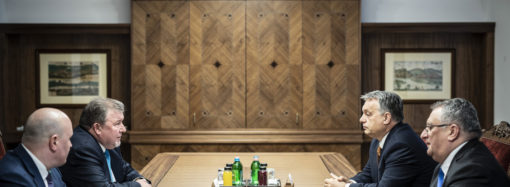
State Secretary Mike Pompeo’s messages, transmitted on Monday in Budapest, deserve the utmost attention. They are not just talking about Hungary. At first glance, it only indicates a desperate attempt by Washington to extract Viktor Orban from Putin’s spell and to turn Hungary as far as possible into the values of the Western world: justice, the rule of law, democracy. In a closer reading, however, Pompeo’s messages target an entire region, they are also about us.
First of all, we should mention the change of tactics. Pompeo regarded the Hungarian officials gently, trying to explain to them that the approach to Russia and China would not bring them anything good in the long run. To the sovereigns who have entered their historical mission, the genre of Orban, one is not going to congratulate them having made democracy nonexistent. If you start with this, you not only lose them permanently, but you risk pushing them even harder in your opponent’s arms.
Pompeo spoke about US values, civil liberties, rule of law, state of law, but did it in the second phase, answering questions from journalists. In a country seriously derailed from the democratic course, the subject could not be avoided. But it was not the main message, as some would have expected. Those worried about the fate of Hungarian democracy were told separately what they wanted to hear.
The hard message, like a bucket of cold water thrown in front of Hungarian officials, was another: “Hungarians know all too well from their history that an authoritarian Russia will never be a friend to the freedom and sovereignty of smaller nations. Russia’s not the only power that wants to erode freedom in this region. I discussed with Peter today about the dangers of allowing China to gain a bridgehead in Hungary, and we talked openly about how we could work together on that issue. There is an experience of states in the Asia-Pacific region that shows that Beijing’s handshake sometimes comes with strings, strings that will leave Hungary indebted both economically and politically. (…) Too often in the recent past, United States was absent from Central Europe. That’s unacceptable. Our rivals filled those voids. (…) We’ve now had 14 senior-level U.S. visits throughout Central Europe in just the first two years of this administration. I won’t tell you how many there were in the previous administration, but it starts with a “Z.” ”
Here are two great observations to make. First of all, Pompeo’s messages are in perfect agreement with the new American strategic position expressed last year by Wess Mitchell, an excellent connoisseur of Central and Eastern Europe, when he was the Deputy Secretary of State.
During his visit to Bucharest in June 2018, Wess Mitchell acted and spoke exactly as Mike Pompeo did in Budapest on Monday. We have noted the following about the following changes in Washingtown’s attitude towards Romania:
“The harsh accents are missing from Wess Mitchell’s speech, no one saw the finger pointing towards the enemies of a state of law in his speech at the Faculty of Law in Bucharest, nor did the classical worries, even though he had all the reasons in the world to express them in these difficult moments. Even today, Parliament passes the amendments to the Criminal Procedure Code criticized by magistrates. No mention of the mutilation of criminal law. The US official’s approach had a rather positive and optimistic note. Part of the explanation is that we are all in a totally different landscape than a few years ago, but Romania should not be thrown into the enemy’s arms but encouraged. The other part of the explanation is a tough reality, something harder to swallow: the Trump administration seems more focused on contracts and business than on the democratic export of values and rules, comes with a more transactional approach to bilateral relations. ”
How much like the messages sent to Budapest! From Mitchell’s speech, as in Pompeo’s speech, there were no warnings about Russia and China’s trade ambitions in the region, the new danger to the Black Sea. In both speeches we will find the same elements of pragmatic approach: 2% for the military, investment in energy to replace Russian gas with US gas.
One thing is still not clear enough. In what measure does the investment of Americans in Central and Eastern Europe (New Europe) and the support given to authoritarian, sovereign, Orban regimes no longer pursue a goal, something more harsh, as well as limiting the influence of Russia and China in the region. If America under the Trump administration really tries to break Europe in two to eliminate a competitor?
European Council President Donald Tusk accused last November US President Donald Trump of opposing the creation of “a united and powerful Europe.” “For the first time in history, we have an American administration that is not enthusiastic, not to say more, to a united and strong Europe,” Tusk said. “I speak here of facts, not of propaganda,” the former Polish prime minister continued, without explaining or exemplifying.
If we are, for example, to choose between the EU and the US, what will we do? I am afraid that Romania is again under a historical wave and that it is not prepared to cope with it.
Source: G4media (Translation TFP)















Leave a Comment
Your email address will not be published. Required fields are marked with *