




For some strange reason Viktor Orbán is unwilling to let his people know about his travel plans, especially if he is going eastward, and therefore Hungarians often learn from foreign sources that their prime minister is within hours of departing. Almost as if he wanted to avoid criticism of his diplomatic preferences ahead of the actual event.
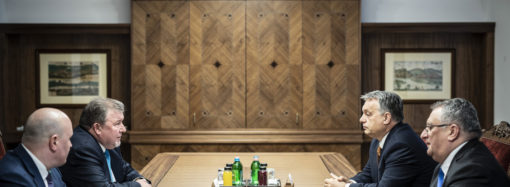
This was again the case when a few days ago the Hungarian public learned from the Kyrgyz Akipress that “the presidents of Kazakhstan, Azerbaijan, Turkey, Uzbekistan, and the Prime Minister of Hungary [will] attend the opening ceremony of the World Nomad Games.” The event celebrates ethnic sports practiced in Central Asia and includes delegations from the former Soviet republics of Kyrgyzstan, Kazakhstan, Azerbaijan, Uzbekistan, Turkmenistan, Tajikistan, and Russia as well as other countries like Mongolia, Turkey, and Afghanistan. Magyar Narancs figured that Orbán attended these events because the trip offered him an opportunity to meet the Azeri, Kazakh, Turkish, and Uzbek presidents in addition to the host, Kyrgyz President Sooronbay Jeenbekov. It didn’t go unnoticed that all political attendees were hard-core autocrats.
As expected, Viktor Orbán wasn’t merely interested in admiring the competition of wrestlers on horseback. The trip also involved a formal official visit, which included participation in the Cooperation Council of Turkic Speaking States in Cholpon-Ata. This news didn’t ring alarm bells in the Hungarian media, as it should have. What on earth does Hungary have to do with the Cooperation Council of Turkic Speaking States? What is Viktor Orbán up to?
The Cooperation Council is an international body established in 2009 by Azerbaijan, Kazakhstan, Kyrgyzstan, and Turkey. The organization was “constructed on the four main pillars of common history, common language, common identity, and common culture.” By now it has built up a network of related and affiliated organizations, like the Parliamentary Assembly of Turkic-speaking Countries (TURKPA), the International Turkic Academy, the Turkic Culture and Heritage Foundation, and the Turkic Business Council.
I suspect that most of these organizations are unknown in Hungary, and therefore Orbán’s information that Hungary joined the Parliamentary Assembly of Turkic-speaking Countries as an observer in 2014 most likely came as a surprise. That’s no wonder, since at the time Hungary’s decision to join the organization was not exactly advertised. I found two sources that mentioned the event: an article on Kurultaj’s internet site and the text of a speech delivered by Sándor Lezsák, one of the deputy speakers of parliament who is a great promoter of the Turanian idea and one of the chief sponsors of Kurultaj. The speech, available in English, was delivered at the fifth session of TURKPA. Therefore, I assume that Sándor Lezsák and possibly László Kövér are behind the latest attack on science by the Hungarian far right.
I found even less on Hungary’s decision to submit a membership application to the International Turkic Academy in 2017. Even the archives of MTI yielded nothing on this request. But, as Foreign Minister Péter Szijjártó joyfully announced yesterday, the petition received a favorable review. We also learned yesterday that Hungary has requested observer status in the Cooperation Council of Turkic Speaking States which, I’m sure, will also be granted.
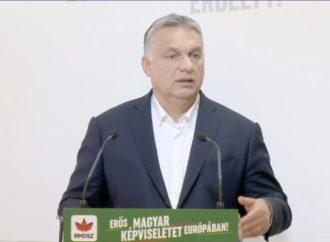
All of these efforts by Viktor Orbán to befriend the eastern autocrats might be good for a laugh if they didn’t entail the falsification of the origin of the Hungarian language and of prehistory. I’m sure that some of you who have been with Hungarian Spectrum for quite a while remember Johanna Laakso’s article titled “Brave New Linguistics.” Johanna Laakso is a professor of Finno-Ugric linguistics at the University of Vienna. This article gives an overview of what’s been going on in the field of linguistics in the Orbán era, but I’m sure that even she would be surprised that Viktor Orbán went so far as to deny the Finno-Ugric origin of the Hungarian language or to declare that the Huns and the Hungarians are close ethnic and linguistic relatives. Because this is what Orbán said in his speech at the meeting of the Cooperation Council of Turkic Speaking States in Cholpon Ata.
The speech, as with Orbán’s speeches in general, is full of questionable statements, starting with the claim that Hungarian is “a unique and strange language related to the Turkic languages.” First of all, every language is unique, unless he is using the word here in the sense of “extraordinary,” which would also be a ridiculous proposition. Because of the spread of Turanism in Hungary, which, by the way, has been financially supported by the Hungarian government, the Hungarian Academy of Sciences felt compelled to publish three popular articles on the early history of Hungarians by a linguist, an archaeologist, and a paleoanthropologist, trying the set things straight.
Early Hungarian history fascinates a lot of people, who can easily be led astray by the growing number of pseudo-scientists who give lectures left and right about topics they don’t really know much about. A good example of these amateur “scientists” is Miklós Kásler, recently appointed minister of human resources responsible among other things for culture, who became infamous as a result of his ignorant remarks about King Béla III’s DNA and his “Finno-Ugric origin.” Now it seems that Viktor Orbán has thrown his lot in with this group of pseudo-scientists, although a few years ago he categorically stated that Hungarian’s Finno-Ugric origin is a “historical fact.” But that was in Helsinki. It seems that in Kyrgyzstan the “historical fact” is different.
Knowing how the Orbán regime’s fawning supporters behave, I’m certain that from here on the government media will be full of idiotic stories about the Turkic origin of the Hungarian language, Hun-Hungarian relations, and other nonsense that will only aggravate the already sad situation that exists in the field of linguistics and Hungarian prehistory. For a politician to take up the role of arbiter of scientific inquiry is a dangerous proposition. But in Hungary, where the Turanian movement has had powerful supporters, like László Kövér and Sándor Lezsák, Viktor Orbán seems to be picking sides, and I am waiting for some wise words on the subject by Miklós Kásler. The next thing will be another attack on the linguistics that is taught at the universities and pursued in the research institutes of the Academy.
Those with some knowledge of the Stalinist period recalled the debate among Soviet linguists about N. Ya. Marr’s theories of language. After the appearance of several articles in favor of and against Marr’s theory, Stalin decided to enter the fray. He denounced Marr’s theory as “anti-Marxist,” which ended the debate. Stalin’s article, by the way, is available on the internet in English. Marr’s theory was bonkers, but that is beside the point. Stalin knew nothing about linguistics, and his argumentation was anything but scientific.
I’m afraid that believers in the unscientific linguistic ties between Turkish and Hungarian will feel empowered and lead scientific inquiry astray. Another round of the “culture war” will begin, following the attacks on literature, films, and popular music. This time the victims will be Finno-Ugric linguists.
Source: Hungarianspectrum









Leave a Comment
Your email address will not be published. Required fields are marked with *