




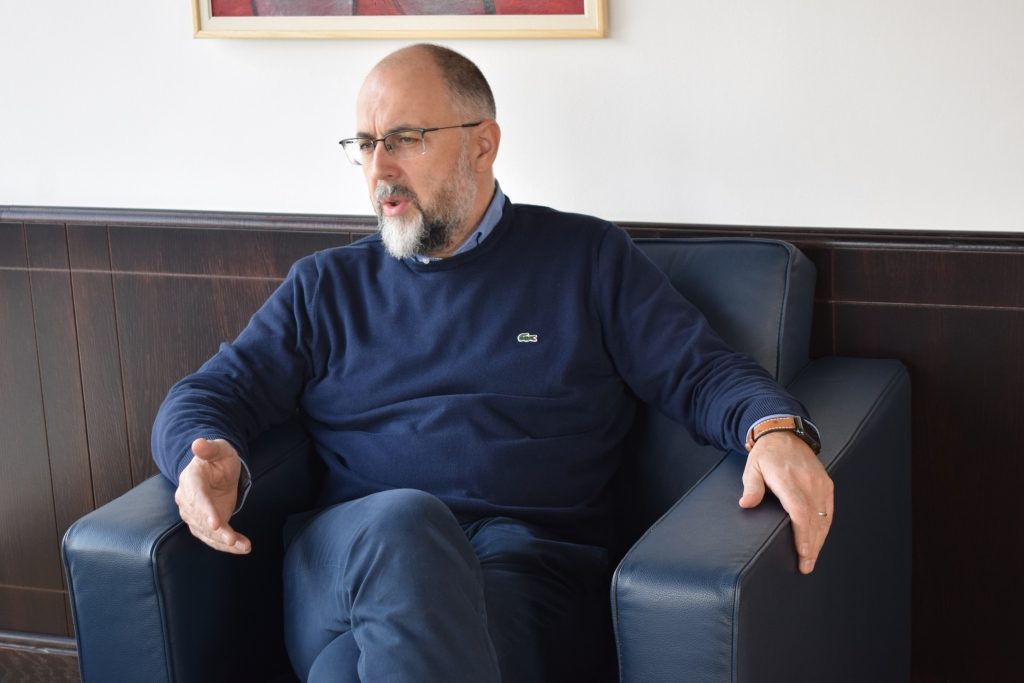
What would you consider as the most important result of your being as a DAHR (RMDSZ) chairman, was there any decision that you regret? How do you see the upcoming Renewal of Congress and the European Parliament elections? Kelemen Hunor, who is the only candidate for the presidency of the DAHR, has been asked.
You haven’t had any competition at the February Renewal Congress for four consecutive years. Is it a positive or negative message to the DAHR president about the state of the organization?
The message is neutral. It’s not my job to judge whether this is good or bad. There were more situations in the 29-year history of the DAHR: there were times when there were competitors, and sometimes there were not any. Eight years ago, there were three candidates for the office. I haven’t had any competition for four years. But I don’t shape that. If they wanted to, everyone could run for the president this year as well.
Eight years ago, you won your first presidency, at that time you were challenged by Péter Eckstein-Kovács and Gergely Olosz. Both were major politicians of DAHR from different generations. In the meantime, the former stepped out of the alliance, the latter is being sought by the police. Does this say anything about the so-called cadre policy of the DAHR?
Nothing. Everyone should take responsibility for their decisions in politics as well. A lot of people have worked in the DAHR over the last three decades. There were all kinds of people like Transylvanian Hungarian society is also a complex society. I can bring a lot of examples for DAHR members who have done their job with excellent performance, commitment and perseverance. The political or other performance of Eckstein or Olosz does not degrade the DAHR’s cadre policy, either before or after 2011.
Actually, I asked Gergely Olosz in 2013 to resign after a criminal prosecution started. Then he told me what was going on in his case and I told him that this situation could be resolved by his resigning. He took this advice then.
Which is the most important result of the last four-year or even eight-year presidential mandate as the head of DAHR?
The DAHR president always has a complex task. On one hand, he must lead the political advocacy, coordinate it at the level of fractions and territorial organizations. You also need to define what to do concerning building the community. At the same time, the context cannot be ignored when preparing the balance sheet. We have to look at the political opportunities we have had over the past eight years and how we have used these opportunities.
We’ve been in the opposition for the past eight years and we were on the government twice. There was a time when we weren’t in the government, but we were looking for cooperation with one of the parliamentary parties. We’re just in such a time now. It is important that we were able to strengthen our parliamentary representation in 2016. We were able to stand up again to the level of proportional representation in recent elections. If we consider that the size of the current Parliament is smaller than the previous one, and our fraction has become larger, then it is clear that we were able to restore proportional representation. It is also important that we were able to raise our presence in county governments. We were able to enter into an alliance with the Hungarian Civic Party, and we were able to realize the cooperation that was constantly in demand in the Transylvanian Hungarian society. I am confident that we will be able to take this collaboration further, but there are conditions for this. During my election, the DAHR performed well in each election.
In addition, in the past eight years, the DAHR has retained and strengthened its ability to enter into alliances with Romanian political actors. In Romanian politics there has always been an endeavor to isolate the DAHR. This has been the case for the past eight years, but we have always found the opportunity for dialogue with one of the parliamentary parties or the other. This means that the DAHR is considered to be a serious political factor, despite the fact that the 6.5 percent parliamentary ratio is not much.
Regarding legislation, we had to face many challenges that were completely different from the previous period around the EU. The acquired rights had to be preserved and this was a great success. In the field of education, we were able to move forward with some of the legislative changes introduced in the last two years, and where we could interpret the law we tried to clarify it. An example of this is the law proclaimed a couple of days ago, which we voted for with the parliament and which settles the issue of Hungarian teachers teaching in Romanian. There are many such examples that are not listed now.
I consider the development of the international relations of the DAHR a great step forward in recent years. I refer not only to the Minority SafePack, which we have worked out together with FUEN, but it was our initiative. We organized the Hungarian-Hungarian relations so that we partnered with the Fidesz-KDNP, with whom we are together in the People’s Party. We have also performed in social construction in recent years. If we only look at the last year, 1000 years in Transylvania, 100 years in Romania, I think if we did not fully, but partly fulfilled the goal. The completion of that part that did not depend only on us. I am thinking of making the dialogue with the Romanian majority livelier and more constructive. That didn’t turn out the way we would have liked it to, we still have a lot to do in this matter.
Have you made any decision as president of RMDSZ, which you reevaluated or regret in the meantime?
Maybe if I could turn back the time to 2012, I would try to stop the Ungureanu government from falling. The change of government at that time determined a lot for the next period. The USL has been strengthened, it has come to power, and the 2012 elections would have been different if they were not in government that year. Then I was the one who pulled the strings because of MOGYE, and it was a strong component of the mistrust that led to the fall of the Ungureanu government. But I am not sure today that if there was no government resolution on the MOGYE situation, there wouldn’t be something else. Then I did what I had to do as RMDSZ chairman for the medical university in Târgu Mureş. Unfortunately, we were not able to solve the situation of MOGYE either because the administrative court had overthrown the government’s decision, but we overthrew a government after which there was a completely different way of politicizing, which produced chaos in domestic politics after 2012.
If you are re-commissioned, what will your main task be?
We have to keep our alliance ability. We need to strengthen our international relations, we must continue the Minority SafePack initiative after the European Parliament elections. We need to continue building the community and investments from the domestic budget. The most important thing is that we can further strengthen the interest representation in politics with our colleagues based on the accumulated experience, knowledge, the relationships established in the alliance, so we can answer correctly to the challenges facing the Hungarian community in the coming years.
At the same time, we must clearly see that our ability to enforce interest is sustainable in Romanian domestic politics, but it cannot be pushed beyond a certain level. In order to keep this, international relations must also be built. These two complement each other, but they cannot replace one another. Romanian political parties have a willingness to adapt when they receive signals from international partners. I have also seen that we have had an impact on our shadow reports in the last two years on the implementation of the language charter and the minority framework convention in Romania. Our shadow reports showed what was wrong with the Romanian foreign affairs reports and pushed the understanding of the situation toward balance. These are still needed.
The agenda of the renewal of the Cluj Congress seems like only a formality now. What will be the stake of Congress?
In some important areas, we need to formulate a vision that will determine our political decisions in the coming years. Identity policy will always be one of our characteristic item on the agenda, even if many are irritated by the fact that we continue to place great emphasis on preserving and strengthening the identity of the Hungarian community in Transylvania. In addition, we will accept documents for infrastructure development and job creation. We will also have a strong message for the youth. Today, the most important thing for us to give the present twenty-thirties a vision for the future. It is possible to curb the emigration, but it cannot be stopped, it is difficult to reverse it. But we want to see those who want to come home from abroad that working in their own hometown is also worthy. Recently we had a chance to talk to a larger group of young people. They belong to the generation that has grown up after the junction to the EU. We asked who wanted to leave the country? Everyone raised their hands
But none of them said that they wanted to leave because their identity was in danger. All of them said they wanted to have higher remuneration, to grow financially faster, want a safer, more predictable life. When we asked if someone would come home later, 60-70 percent raised their hands. They would not go away to live their entire lives away from their homeland. And this is good. With this in mind, it is very important for us to try – with our limited potential – to contribute to a predictable future for young people in Romania. In three or four years, we will certainly not achieve the Austrian standard of living, but that is not the question. I talked to a man in his forties living in London who said: “The amount of money I get here, it’s worth it out there as if you were being paid 3000 RON at home. And if he could earn more at home, he would be happy to come home. I have found that this generation is not going abroad because they become estranged from their homeland, but because they want to try themselves out, want to live better and more predictably. For them, we need to create an economic environment that enables them to do these.
As an old-new president, the first major challenge will be a good presence in the European Parliament elections. What’s more, in an increasingly anti-EU atmosphere that politicians are contributing to, both in Hungary and abroad. How can you convince Hungarian voters in Transylvania to vote in these circumstances?
There is an Eurosceptic atmosphere across Europe. This is not just a Hungarian phenomenon in the Carpathian Basin. The same is true in the Czech Republic, Poland, Italy and even in the northern Member States. The reason is that people are dissatisfied. The political elite lives in the misconception that they know what is good for the people, and the people must listen because they don’t know what is good for them. This is unacceptable.
If communities in Europe are increasingly addressing this problem, then we must look for its reasons. I think there is nothing wrong with the European Union. Rather with some of the bureaucrats leading the EU. They think of themselves like the owners of absolute truth, that they can implement transnational governance. A significant proportion of them are not even elected officials. They guard their positions.
I think everyone today sees that the EU needs to be reformed. This is also seen by those who have been defending the current EU construction for a long time. The Germans are beginning to rethink this, and they no longer believe what they said five or six years ago. Everyone agrees that none of the EU Member States will be competitive in global economic-technological competition. Not even Germany. European nations are interlinked, the continent needs to be strengthened. It is economically strong, but its power may soon fall apart if there is no strong political commitment behind it, no well-thought-out defense and security policy. In this sense, the European Union must be reconsidered. It is necessary to examine what decisions should be taken in the Member States, what should be done in Brussels. It is also necessary to reconsider what decisions should be taken by consensus and by majority vote. I think these competences should be reconsidered today, and if this happens, the people of Europe will trust the political structure of the EU.
In these circumstances, the EP elections should address the need for the European Union to implement reforms and, if we are to participate in European decisions, we must be there. Euroscepticism does not mean absenteeism. It doesn’t mean you that others have to solve our problems. The Transylvanian Hungarian community must be there in the EP to be part of the reforms.
At the same time, the issue of indigenous minorities must also appear in the reforms. There are already good solutions in Europe that can be applied anywhere on the continent.
We must present them at the European Parliament elections. It’s a big challenge, we won’t have an easy job. But 12 years of experience in the EP show us one thing in every way: we should not be left out of these decisions. We need to convince our community of this.
The DAHR has a two-year parliamentary cooperation agreement with the current government parties. PSD and especially Liviu Dragnea’s party president’s opinion is constantly deteriorating, including among Transylvanian Hungarians. What is the answer to those DAHR voters who interpret this cooperation as supporting the power of Bucharest, which many people find incompetent and corrupt?
First, we didn’t elect either PSD or Liviu Dragnea. This is not the responsibility of the DAHR, things should not be confused. We are not responsible for who is the president of the PSD. The job of the PSD is what kind of government they brought together, we were not asked. I completely separate the DAHR from the judgment of the PSD because the DAHR has no responsibility for this party being as it is. I can tell the Hungarian voters in Transylvania that, when the DAHR is judged, they should not tie the alliance to the PSD, the ALDE, or the opposition, anyone.
On the other hand, we have to do something with that 6.5 percent in parliament. I would love to work with the liberals, but I would ask my critics: would you get along well with Ludovic Orban? Or Dan Barna, who blames the Hungarians for the problems along these 29 years? However, it is not us who are keeping this government alive.
They have the majority, with or without us. There are facts, numbers. The DAHR also voted several simple proposals against the ministers along with the opposition, none of whom passed through the parliament. We asked for the establishment of committees of inquiry with the opposition, neither of which received majority support in Parliament.
When I say that we are pursuing a pragmatic policy, it also includes the pragmatism of the alliance. It does not mean, it can not mean any ideological commitment or identity with the allies. On some issues, government parties have helped us in recent times. It also belongs to the big picture that the opposition has attacked the DAHR in every Hungarian case. This does not mean that PSD is good and the opposition is inherently bad. In politics, things change, turn around, and we get used to it.
If I saw an alternative today, I would say let’s start looking for a better government. Maybe the moment will come when there will be an alternative, but now there isn’t any. I understand those who have a very clear ideological position, as I have a clear ideological position as well, but the decisions of the DAHR cannot be made in this regard. If we had 25-30 percent in the parliament, we could afford it. But in minority politics, pragmatism must be decisive. Of course, there may be a point where you cannot cooperate with either one or the other.
Is it possible that the DAHR will not extend this cooperation agreement in the spring cycle?
It does not need to be extended, but it must be terminated if there is a problem. The agreement is for four years and can be reviewed at the end or beginning of each session. If the RMDSZ fractions express the need for breaking up the agreement at the spring session, then we will open a debate and discuss this. But one thing has to be said continuously: don’t mix the DAHR up with anyone. Our parliamentary co-operation with government parties is not automatic, and this was also reflected in the debate on the offshore law or the pension law.
Source: Maszol (Translation TFP)













Leave a Comment
Your email address will not be published. Required fields are marked with *