




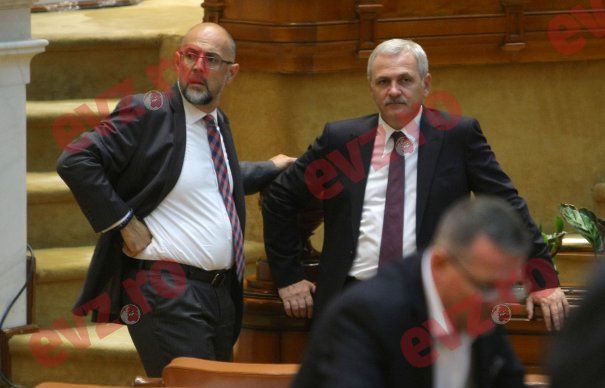
The necessity of the new institution, which was one of the three priorities of the Ministry of National Education in the centennial year, would result from “consultations with the UDMR representatives in the Romanian Parliament”.
After a year ago, having needed the votes of the UDMR parliamentarians, the PSD-ALDE coalition voted in parliament the Hungarian Union’s project to establish a theological high school with teaching exclusively in Hungarian in Târgu Mureş, now gives it as a present to Oradea the Center for Continuous Training. In fact, according to source Event of the day from the Ministry, the dawn to set up the Center comes from the UDMR’s need to give some sinecure to its people before Christmas.
One of the three priorities of the Ministry of National Education in 2018, a 100 years since the union of Great Romania, is the establishment of the Center for Continuing Education in Hungarian, as it says black on white in the Fundamental Note of a Government decision made publicly available on the MEN website. The initiators argue that the establishment of the Center is necessary because in Romania it is necessary to operate an institution that will ensure the continuous training of the teaching staff working at Hungarian study institutions, but also as a result of the request of the Hungarian minority through its representatives in the Romanian Parliament.
It still does not exist, but it has its headquarters
The Center, which will operate in Oradea, on Cluj Street 106, in a building under contract, will “promote innovation and reform in education and provide the framework for professional development in line with professional standards.” It is interesting that the new settlement will cooperate, in addition to educational, academic and cultural institutions, with individuals in the country and abroad, such as the Budapest authorities.
Under the heading “Information on the process of consultation with non-governmental organizations, research institutes and other bodies” in the Fundamental Note, it is written only: “Consultations with UDMR representatives in the Romanian Parliament”, without telling us whether the Union of became meanwhile, somehow, and research institute.
Funding of the Center’s current and capital expenditures will be secured from its own revenues, which makes us think again of the Budapest authorities, subsidies from the state budget through the MEN and funds from international programs and co-operation, where we might also talk about institutions in Hungary, especially since the Center can receive donations and sponsorships. In a nutshell, the ministry may also decide to set up branches of the Center, which will be headed by a five-member Board of Directors. The center will have its own administrative apparatus, organized in an office and three compartments.
UDMR cell from MEN
Those interested in making proposals and comments on the draft decision are advised to contact Gyenge Edit at the mailing address edit.gyenge@edu.ro, who is the counselor of State Secretary Kovacs Iren Erzsebet, Coordinator of the Department of Education in the Minority Languages. This department in the Ministry of National Education has only members of UDMR, no other minority having the right to make decisions. Cabinet director of the state secretary is Borsos Karoly Laszlo, and the other counselor – Kovacs Zoltan Zsolt. Kovacs Iren Erzsebet is vice-president of UDMR women’s organization. Moreover, according to the sources of the Evening of the Ministry, the dawn to set up the Center comes from the UDMR’s need to give some sinecure to its people.
These are priorities
The Ministry of Education has introduced in the Government’s Annual Work Plan for 2018 a number of 21 draft normative acts with an impact on the areas it coordinates, three of which are priorities, and one is the establishment of the Center. Here are the MEN priorities: Government Decision approving the methodological norms for the application of the provisions of Government Emergency Ordinance no. 92/2017 regarding the approval of the pilot program for granting food support for pre-school children and pupils from 50 pre-university education units; Government Decision amending and completing Government Decision 1252/2012 on the approval of the Methodology for the organization and functioning of crèches and other early pre-school education services; Government Decision on the Establishment of the Center for Continuing Education in the Languages of National Minorities. The Government’s Annual Work Plan (PALG) is part of the Better Regulation Strategy 2014-2020, elaborated by the General Secretariat of the Government to carry out the strategic planning process.
The National Parental Education Strategy, another “fent” of MEN in 2018
Although not found among the 21 projects MEN had proposed in January to promote them by the end of the year, the National Parental Education Strategy was pushed forward in June and withdrawn only after Day Event and dozens of non-governmental organizations drew attention to its toxicity. Mihai Gheorghiu, chairman of the Coalition for Family Initiative Committee, then said that the draft “National Strategy for Parent Education” was “the most toxic document issued by the Romanian state after 1945”, which proved that the Romanian state decided to act decisively against all Christians from Romania.
“The Romanian state has decided to act decisively against all Christians in Romania. By re-educating the parents, by deconstructing the models and values shared by millions of Romanian Christians. By allocating € 70 million annually for the unconstitutional elimination of a life-style and perpetuation of life.
High School established by the Order of the Minister of Education
Romano-Catholic Theological Highschool “II. Rakoczi Ferenc “was established in August, based on an Order of the Minister of National Education. By the Order of Minister Valentin Popa, the temporary functioning authorization was granted to the Roman Catholic Theological High School “II. Rakoczi Ferenc “, which includes 26 study groups with 28 children each, the agency writes.
Director of the high school was named Zsolt-Jozsef Tamasi, former director of the old Roman Catholic Theological Highschool, disbanded by court. The Old Roman Catholic Theological High School disappeared after the final sentence of the Târgu Mureş Court of Appeal of February 6, 2018, which annulled Decision no. 1385 / 31.08.2015 issued by ISJ Mureş for the establishment of the Roman Catholic Theological High School in Târgu Mureş through the partial division of the Bolyai Farkas Theoretical High School and the Unirea National College.
In November 2016, the National Anticorruption Directorate started the prosecution against the former head of County School Inspectorate (IŞJ) Mures Ştefan Someşan and the former director of Târgu Mureş Lyceum, Zsolt-Jozsef Tamasi, prosecutors arguing that the establishment of high school was done in violation of the law education. The two were sued and the file was then returned to the DNA. At the beginning of the school year 2017-2018, based on the suspension of the decision to set up the High School, the students enrolled in this unit were assigned to the “Bolyai Farkas” Theoretical High School in Târgu Mureş.
In March this year, the Constitutional Court of Romania accepted the notification of PNL and PMP, the draft law passed by Parliament on the establishment of the Roman Catholic Theological High School in Târgu Mureş being declared unconstitutional. On August 9, this high school was established by order of the minister.
Source: EVZ (Translation TFP)












Leave a Comment
Your email address will not be published. Required fields are marked with *