




After Poland and Hungary, the European Parliament turned its attention to another trouble spot, Romania, which seems to be following in the footsteps of Hungary and Poland, two countries that in the past few years have undermined the very foundations of the rule of law. Admittedly, the Romanian government hasn’t gotten as far as its models, but the European Union, learning from its past mistakes, believes that early intervention is necessary. Unlike with Poland and Hungary, Romania is not facing the threat of the nuclear option of Article 7, which may involve the loss of voting rights in the European Council. The resolution that was adopted by the European Parliament with a large majority is only a “friendly” warning, at least for now.
The list of complaints about the present Romanian government is long. The prime minister, Viorica Dăncilă, is basically a puppet of Liviu Dragnea, the chairman of the ruling Social Democratic Party who in June 2018 was sentenced to three and a half years in prison for “incitement to abuse of office.” It looks as if the current changes to the Romanian judiciary are being introduced to save the skin of Dragnea, who is currently the president of the Chamber of Deputies.
The European Parliament’s resolution claims that the redrafted Romanian pieces of legislation addressing the judiciary and criminal offenses potentially “structurally undermine the independence of the judicial system and weaken the rule of law.” The resolution urges the Romanian authorities to counter any measures that would decriminalize corruption in office. It strongly recommends reconsideration of the legislation on the financing, organization, and functioning of NGOs, which has an intimidating effect on civil society. It expresses “deep concern” regarding restrictions on media freedom. The Romanians are planning to penalize “denigration of Romania abroad and reintroduce defamation in the criminal code.” Doesn’t even that partial list sound familiar?
The resolution was voted on during the November 13 plenary session of the European Parliament, where it passed with 473 supporting votes, with 151 against and 40 abstentions. Let’s take a closer look at the breakdown of the votes. The present Romanian government is allegedly social democratic, so it is not surprising that of the 217 EPP members only 10 voted against the resolution. What, on the other hand, I find astonishing is that the usually careful Viktor Orbán decided to take a stand. Eight of his underlings in the European Parliament didn’t just abstain but openly voted against the resolution in defense of Romanian corruption and its attack on the rule of law. Even a social democratic party is acceptable by this very Christian democratic party as long as it is corrupt to the core and the man who is pulling the strings has been convicted of electoral fraud, for which he received a two-year suspended sentence in 2016. Orbán has a penchant for associating with formerly convicted persons, be they Romanian, Slovenian, or Macedonian.
The eight dissenting Fidesz MEPs were Andor Deli, Tamás Deutsch, Norbert Erdős, András Gyürk, György Hölvényi, Lívia Járóka, Ádám Kósa, and György/George Schöpflin. The other two dissenters were Nicolae Mănescu, a Romanian, and Anna Záborská, a Slovak Christian Democrat. Hungarian MEPs who represent opposition parties naturally voted for the resolution, including Jobbik’s Zoltán Balczó, who abstained on the Sargentini Report.
The Hungarian government media didn’t spend much time on the issue and certainly didn’t advertise the fact that the Fidesz MEPs had voted in defense of a corrupt Romanian government. On the other hand, Magyar Idők published an article from a stringer from Târgu Mureș / Marosvásárhely titled “Does Brussels want to overthrow a government?” It reported on Prime Minister Viorica Dăncilă’s outrage over the passage of the resolution. Here is what she had to say, according to an English-language Romanian internet news portal. “It is definitely a political resolution. It is profoundly incorrect and, in at least a few points, it is not justified, while in other points it doesn’t even refer to Romania. This resolution is the expression of the electoral interests of the great political groups, namely the People’s party—who are the majority—and the Social Democrats.” Apparently, Dăncilă, similarly to Donald Trump, has serious problems with her mother tongue.
Other Romanian politicians expressed their dissatisfaction with the resolution in stronger terms. Florin Iordache, a social democratic politician who is currently involved in the efforts to “reform” the Romanian judiciary, called the resolution “revolting” and made an obscene gesture regarding the institutions of the European Union. It looks as if the Hungarian government agrees with Viorica Dăncilă and Florin Iordache because Zsolt Pászkán, the “Romanian expert” of the Institute of Foreign Affairs and Trade, a think tank serving the Szijjártó ministry, supports the Romanian prime minister’s assessment of the EP resolution: it is being used as a political weapon against Romania.
And finally, a few words about George Schöpflin, one of those in the Fidesz delegation who voted against the EP’s warning resolution to Romania. He has spent almost his entire life in the United Kingdom, where he was a professor at the School of Slavonic and East European Studies, University College London. Since 2004 he has been a loyal enabler of the regime of Viktor Orbán as a perpetual member of the European Parliament.
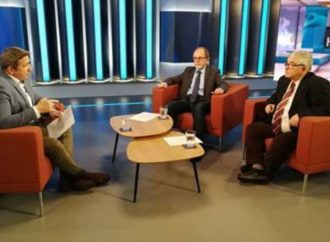
Friday evening he was the guest on ATV’s Egyenes Beszéd Kontra, a relatively new interview program in which three reporters normally ask pretty hard questions of their interviewees. I have seen some disgraceful interviews, but this one topped them all. Schöpflin showed himself to be spineless and amoral. The reporters were mostly interested in two recent issues. The first was the Gruevski affair and the second, the European Parliament’s resolution on Romania. Our learned man turned out to be a self-styled dolt who knows nothing about what’s going on in Macedonia, in the European Union, or in Hungary. According to Schöpflin, as far as Hungarian assistance to Gruevski’s escape from justice in Macedonia is concerned, it is not interference in the internal affairs of a foreign country. On the other hand, demanding Romania’s adherence to the laws of the European Union interference is interference in the internal affairs of that country.
Furthermore, since it was a long time ago that he last visited Macedonia, he knows nothing about the country because he is too busy with his work on the EP’s committee on constitutional affairs. He never heard about Gruevski’s propaganda against changing the name of the country in order to open the gate for Skopje to join NATO. He doesn’t know that Viktor Orbán campaigned for Gruevski, basically against Macedonia’s becoming a member of NATO. He knows nothing about OLAF’s investigation into the shady affairs of Viktor Orbán’s son-in-law. And as a former professor he has no sympathy for Central European University which, echoing Lajos Kósa, is “many universities.” And when one of the reporters wanted to know whether he doesn’t find it embarrassing that a recent Fidesz candidate for office was talking about “Jewish and Freemason conspiracy,” he announced that this is stupidity. It is not a “conspiracy” but a “big project” that aims at the global supremacy of capital over governments. And this man has been sitting in the European Parliament for the last 15 years, expounding his alleged academic knowledge in mannered English and mannered Hungarian.
Source: Hungarian Spectrum















Leave a Comment
Your email address will not be published. Required fields are marked with *