





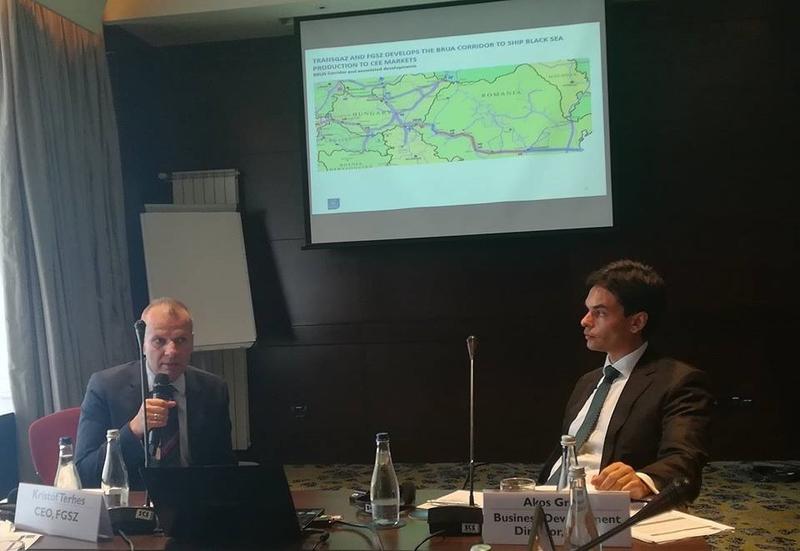
An unusual press conference was held in Bucharest on Wednesday, organized by FGSZ, Hungary’s gas transportation company. It is important to note that no Romanian official participated at this conference, not even from the Romanian Transgaz gas carrier, as it is a partner of FGSZ in the BRUA project. In this context, FGSZ Chief, Kristof Terhes, launched provocative messages on Black Sea gas production, consumption in Romania and BRUA pipeline interconnection. Last year, Hungary unilaterally decided to stop BRUA on its territory, not to invest in the interconnection with Austria, as envisaged in the original project and to redirect the gas to other neighbor countries.
(Note: According to HotNews.ro, Transgaz representatives only learned the day before that their Hungarian partner was due to hold a press conference in Bucharest and the journalists had been invited a week earlier.)
We also recall that following a bid organized in December, the gas transmission capacity through BRUA was reserved by two companies in Hungary until 2037.
These statements were made at a time when the final investment decisions are expected in the Black Sea gas exploitation projects.
First Challenge: The FGSZ Chief says Black Sea production will reach Hungary and from there to Slovakia and indirectly to Austria. He also says that transport will also be available to Ukraine, Serbia or Croatia. Basically, the message is that the Romanian gas distribution center is in Hungary.
These statements, however, contradict the recent intentions of the Black Sea operators to deliver gas to Ukraine and Bulgaria, not to Hungary. The operators would use the existing Isaccea transit pipelines (at the border with Ukraine) – Negru Voda (at the border with Bulgaria). There are three transit pipelines: one with a capacity of 8 billion cubic meters per year and the other two with capacities of 10 billion cubic meters per year. There are about 200 billion cubic meters of gas in the Black Sea, of which it is possible to extract 6-7 billion cubic meters a year or more.
Transit pipes would be the easiest and cheapest way to export Romanian natural gas to Ukraine and further to Central European markets because it is very close to the Black Sea coast, according to an ICIS analysis.
The head of the FGSZ, on the other hand, argues that gas delivery through the transit pipelines to the north (Ukraine) and the south (Bulgaria) would not be feasible.
The second challenge: Kristof Terhes has ironically stated that Romania has no capacity to consume the Black Sea gas since it has no industry, neither petrochemistry and the population is connected to the grid only at a rate of 30-35%, while the number is 95% in Hungary. “You do not have petrochemistry, you are not able to use natural gas as raw material, what do you do with the gas, burn it, do a big fire?” The FGSZ chief ironically said.
Romania could, however, use some of the gas surplus that will be produced in Romania for the revival of the chemical and petrochemical industry. OMV has just announced that it will resume petrochemical production.
The third challenge: The FGSZ Chief said that Hungary made “a great” favor to Romania by stopping BRUA on its territory and not leading it to Austria. Having been asked why Hungary has changed its mind about the BRUA project, Kristof Terhes responded in an irritated tone that “your producer” is actually the winner this way. “What does it mean we have changed our minds?” “We have put a plug between Romania and Hungary in the pipeline and we do not let the gas pass through and you lose income?” What we’ve changed is the benefit to you because your producer would use less money in Romania, because it does not have to spend another billion dollars on a new pipeline, since there is infrastructure already in it. We have made a great favor, I gave you a billion US dollars. It seems that you do not understand how these things work, “the FGSZ chief appealed to journalists.
He argues that a pipeline to Austria would have been a “redundant infrastructure” that would have meant $ 1 billion in investments. In fact, Hungary would have had to build a 300-kilometer pipeline in its territory, so BRUA could reach Austria. FGSZ representatives say it is preferable to use the infrastructure they already have and to interconnect with Slovakia and other neighboring countries without building new pipelines. Only small investments would be needed for interconnection with Slovakia. Basically, to divert the BRUA route through Slovakia to Austria. Head of FGSZ also claims that with this option, Exxon might decide easier upon investing in the Black Sea.
However, it is not a favor for the Black Sea producers at all, as the head of the FGSZ does, but on the contrary. The longer the pipeline route, the higher the transit fees. For gas that would reach Austria, additional transit charges would have to be paid, which would be reflected in the price and would no longer be competitive. This idea was also recently expressed by Razvan Nicolescu, former energy minister. “Why do I not cherish this option? It is more expensive because you go into another national transport system, it has no direct impact on Romania, but it has an impact on the operators that produce in Romania. That is, if the gas at Baumgarten is 80 euros / thousand cubic meters, let’s say that directly through Hungary-Austria, the transport costs say that it would be 10 euros. Then the company that produces in Romania will sell it with the difference between 80 euros and transport costs, moreover accepting a discount to the client trader. Let’s say you sell it for 69 euros, give the trader one euro, give ten euros the transport costs. Going through Slovakia, it will not be 10 euro, but 11 euros, 11.5 euros and you will not be able to sell it by 69, but by 68 or 67.5 euros a thousand cubic meters” Răzvan Nicolescu said in an interview for HotNews.ro.
Certain facts: Transgaz started the construction of the BRUA pipeline in Romania in early June. The BRUA – Phase 1 project involves the construction of the 479 kilometres long Podişore-Recaş natural gas pipeline. At the end of the first phase of the BRUA project, the bidirectional flow of natural gas will be secured to Bulgaria via the Giurgiu – Ruse interconnector (1.5 billion cubic meters per year) and Hungary via the Horia – Csanadpalota interconnector (1.75 billion smc / year). The estimated total amount for Phase I is EUR 478.6 million, of which only EUR 180 million is European non-reimbursable funding. The rest of the amount must be covered by loans or own sources. At a capacity of 1.75 billion smc / year, BRUA will be a transit pipeline for gas coming from Greece and going through Bulgaria.
Source: HotNews

















Leave a Comment
Your email address will not be published. Required fields are marked with *