





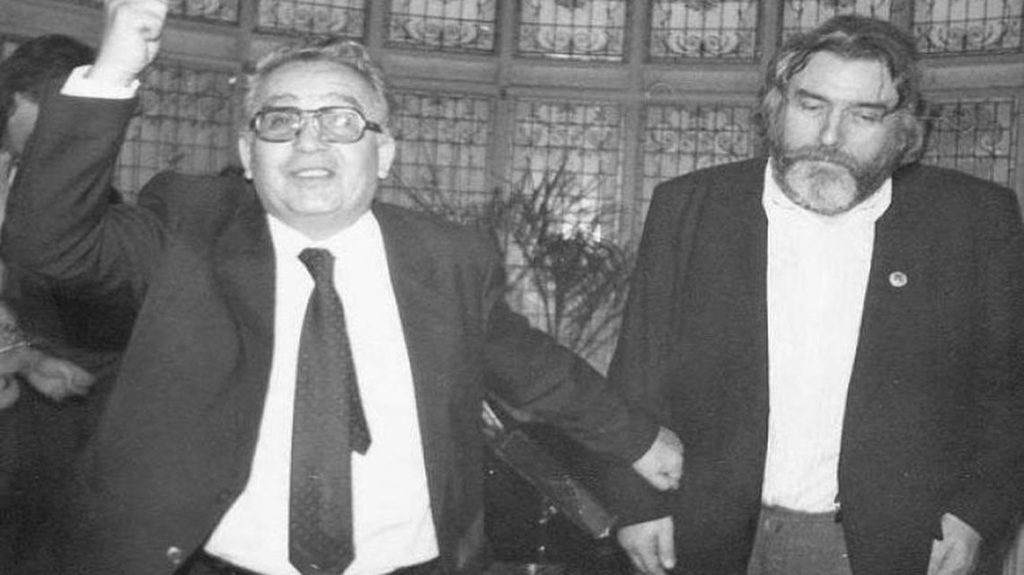
In the past days Romania has celebrated its Centenary of the Great Union. At these moments of genuine celebration, by the pride of being Romanian and belonging to this wonderful country, on the bed of a hospital in Târgu Mureş the 88-year-old, Hajdu Gyozo died – a man of great quality, a real example for the future generations of Romanian and Hungarian children.
Former editor-in-chief, for more than 40 years, of the journal of Hungarian writers from Transylvania, Igaz Szo, president of the Romanian-Hungarian Cultural Association Egyutt-Together for over 28 years and editor-in-chief of the homonymous magazine, this man did nothing else than to pursue permanently, throughout his career, the bringing together of both cultures, Romanian and Hungarian. He wrote thousands, probably tens of thousands of articles on Romanian-Hungarian relations, translated dozens of Romanian and Hungarian books by the poets and writers of the two countries, organized hundreds, maybe thousands of cultural events dedicated to improving Romanian-Hungarian relations.
Almost every day on December the 1st he organized cultural actions in Bucharest or Târgu Mureş, trying to prove that the thesis of the current UDMR politicians and Hungarian officials is a lie, according to which the National Day of Romania is a mourning day . Besides, Hajdu Gyozo was one of the few Hungarian journalists who had the courage to assume the public condemnation of the UDMR’s autonomous wishes and other Hungarian organizations, he had the courage to say that all this fight, strongly backed by Budapest, is no different rather than a chimera, a way for Hungarians with well-paid positions in the central and local administration to keep their seats!
I had the honor, a few years ago, to meet this man by chance. I was simply impressed by his modesty, his simple way of looking at things and, at the same time, the depth of his actions. Without benefiting from the financial support of any cultural institution in Romania, permanently blasted by UDMR for not supporting the policy of this organization, Hajdu Gyozo has always believed in his destiny to bring ordinary people toghether, Romanians and Hungarians, regardless of their political choices. I was also impressed by his vision of life.
Self-defined as a strong left-wing man, the Hungarian journalist never had the intention of enriching through his actions. On the contrary, he was proud that his only fortune, an invaluable one, was the books and articles left behind, the culture he had tried to create through what he had done for over 68 years. And so he lived his own life. Writing permanently, with an extraordinary vitality, even at 88, with an agile, enigmatic mind, a man who, through his energy and good mood, made you think that the person is 30 years old in front of you, eager to takes his life in the chest. In front of him, self-defined people of the Hungarian culture, such as Marko Bela, Kelemen Hunor, or Suto Andras are small children. In the face of Hajdu Gyozo’s activities of bringing the Romanian and Hungarian people through culture, the actions of the Ministry of Culture and National Identity are tiny, if not non-existent.
Unfortunately, three days before December 1st , three days before the Centenary of the Great Union, God wanted to take Hajdu Gyozo into heaven. Perhaps he wanted to stay there for Centenary, next to his great friend Adrian Paunescu, with whom he wrote history in Romanian journalism. Without exaggeration, I think we owe a lot to this simple man, but the most important is the idea that the Romanian and Hungarian people must live in peace and quiet. Optimism, modesty, appreciation of small things, simple, accessible to anyone, are lessons left behind by the Hungarian philosophy of life. And to all these things I would add one more: the backbone. This man never denied his political beliefs, even if they did not fit the times, never denied the belief that by culture two peoples could approach, he never denied the belief that good and harmony would eventually overcome. This is a life lesson that Hajdu Gyozo has given to many people …. it is a lesson of life he has given, including many Romanians for whom patriotism is a notion they have only found in the books of history … but it is a lesson of life that he gave to many Hungarians who suddenly claimed that they did not feel well in this country …
These days, the Romanians and the Hungarians have lost a great personality in the journalism … but all Romanians and Hungarians have a wealth of positive ideas written by this man … it is enough just to read a few of them to realize that the understanding and the harmony among the ethnicities is the only way to go in this area of Europe permanently milled by conflicts.
Rest in peace, Hajdu Gyozo!
Source: Historia.ro (Translation TFP)
















Leave a Comment
Your email address will not be published. Required fields are marked with *