




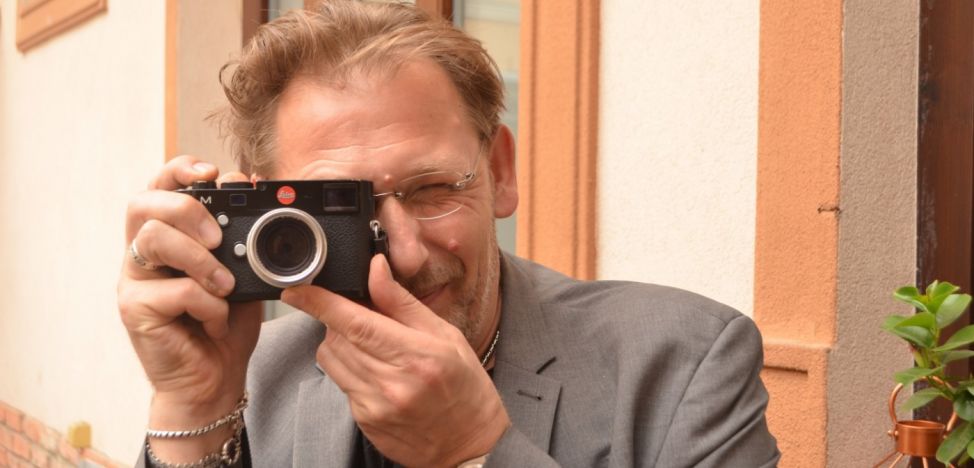
Writer Attila Bartis was in Târgu Mureş for the opening of the personal photo exhibition at the Palace of Culture, titled “On the islands”, and accepted the invitation of the Podium Association to attend a meeting with high school students during the Hungarian literature classes, for the project titled “School Writers”.
The hosts of Attila Bartis were Hungarian language and literature teachers at the Târgu-Mureş High School of Art, Kozma Edit and Szabó Erzsébet. During these two hours, the famous writer spoke about his writing career path, the mechanisms of creation, the challenges and the satisfactions of his vocation, the play adaptations of his texts, the importance of literature in contemporary society, and the passion for photographic art. Students were encouraged to intervene with personal questions, to which Attila Bartis responded with pleasure and sincerity. All those interested could ask questions and at the end of the hours they asked for dedications and autographs, which the writer offered generously.
Attila Bartis then found time to talk with the the organizers, and give an interview on this occasion. Even though Romanian has not been frequently spoken much, the writer has found his words and communicated in his specific, calm, serious and profound manner, marked by a posture in which optimism and love of life merged.
Andrei Vornicu: Do you write for a certain audience or age or do you think what you write is appropriate for young people or high school students?
Attila Bartis: When you write literature you cannot do it for a certain audience. You can write SF for a certain audience, but not literature. If you write for the public, then you just committed suicide. What you wrote would be, in the best case, only important for that audience, but you have no chance to become important to the rest of the people. By doing so, you lose your freedom as a writer. For me, that seems like a trap, but there are other types of traps. If that was important during writing then I would have never written “Walking”, because in Hungarian language there are no genders, and the book is a game of between the genders. It is not mentioned if the story is about a girl or a boy, but I, who apart from Romanian and English do not speak another language, would have thought that if I wrote this book it could not be translated into any other languages. But you have to write what comes naturally and what’s important to you, and of course you feed the hope that it’s important for someone else also, not only for you. It has to be relevant to other people, but there are many ways, and if you write for children, for example, you know you write literature for children, but it’s very important not to lose your freedom as a writer.
A.V .: What does freedom as a writer mean to you? Or what freedom does writing offer to you?
A.B .: If I want to make a comparison, writing is in a way like archeology. When a man writes, he writes not only what he already knows, but he learns a lot of things during writing. What I write affects myself. I am a kind of reader of my text and I cannot imagine that after writing something, once I have finished it, I will remain the same person. This process changes me, not only in the case of literature, but in the case of plastic art too. It is archeology, a form of finding your deepest roots, of reaching your essence: why are you, who you are, what happens to you. You discover things about the existence of the world. This is the greatest freedom a person can have, facing a white sheet of paper and with everything in you and the life experience you have, you create a new world. But it would be a very big mistake to confuse this with a godlike attitude. The creation of man will always be the creation of man, but it is also a great freedom.
A.V .: Have you ever been afraid while writing?
A.B .: Yes, it has happened to me many times. For example, the most notable was even “Tihna”. I wrote “Tihna” the following way: every day, when I got up, I started to write, but I never read what I wrote yesterday, I only read it once I finished it all. Then I was really afraid, because there were some emotions and things I didn’t know where they originated from. It was clear that these did not belong to me, and it was a big question if I wanted to publish this book or not. And that was not easy, to make the decision that this comes from me, I wrote it, and as literature it must be published. It was not easy at all, but it also represents the meaning of writing literature. It’s hard, but that’s no problem (laughs).
A.V .: How much do you intervene on the text after finishing a book?
A.B .: It depends on the text. I wrote some texts that I worked very hard on, but some I didn’t change at all, and this process is certainly important to me, but I think for the reader it doesn’t matter if I worked 15 years on it or I wrote it in a month and a half. But if I have to work too much on a text, there’s a problem. Something is not yet clear in you, and maybe it’s better if you leave your work aside for a while and pick it back up in a few months or a few years.
A.V .: Do you write by hand, on the typewriter or do you have any other preferred way?
A.B .: Like everyone else, I started with the pen and a notebook. Nowadays I mostly write on my laptop, but I also need a sheet of paper, to see the text as an object, to be palpable. It happened once that I wrote it on the laptop, and as a student, I copied from the screen on a paper, after which I typed it back into my laptop. I feel much better if I have a pen and a notebook with me. If I do not have my laptop, it’s not a big deal, but if I do not have the pen, I feel bad.
A.V .: To what extent is, in Hungary, contemporary Hungarian literature promoted in the school curricula?
A.B .: I think there is a big problem with the school system in Hungary. I do not know how it is here in Romania …
A.V .: In principle, almost all the writers students learn about are dead for a long time.
A.B .: It is the same situation in Hungary, and I think the system is teaching literature in a chronological order, from the beginning until today, but they never reach present times. After the Second World War, the 12th grade is finished, and they do not reach contemporary literature, with the exception of a couple of professors. I think the opposite should be done: start from contemporary literature, somehow, and then do some research and go back in time to see where the roots of literature and today’s life are. That seems more natural to me. This current system is not so good because it does not help you fall in love with literature, and the purpose of school should be to make literature become important.
A.V .: Don’t you think a reevaluation of the literary canon is necessary? And, eventually, to give up some of the works that are outdated and do not teach anything essential about the contemporary man. Or is this too risky?
A.B .: I understand this view and it was also discussed in Hungary, but I think it is very risky. I do not think we have to give up some 18th or 19th century authors, but we have to find another way to get to them. They have been and are still important.
A.V .: I approached this in the context of the number of hours the professors have available, number of hours spent on some works, and due to this some pieces that are worthy to be taught are left out.
A.B .: Yes, this whole system should be rethought. But, for example, I could not wholeheartedly say let’s stop learning Petőfi Sándor, because love him or not, he is one of the greatest poets, not only among Hungarians, but also among Europeans. Likewise, I could not say let’s not read Eminescu anymore. Maybe we do not love him so much in 2018, but he put something on the table. A more important question would be: how do we reach Eminescu in a better way? Just as the English are wondering: what do we do with Shakespeare’s language? How can we understand it today? That’s not easy at all, but it’s a matter of literature everywhere.
A.V .: Your books have been translated into many languages and read by many nationalities. What do you think resonated from the content of your books with readers from other countries? What’s the common ground?
A.B .: This is a very important aspect because, as we have seen in different languages, in different countries, text layers work differently. In Germany, for example, the political layer was very important to readers. In Poland, the relationship with God was very important. In China, the parent-child relationship was very important. There, until today, there is a very strict hierarchy in the family, and for them it was unbelievable that a child can say no to its mother. It is clear that in different cultural areas the text has a different meaning, but it seemed to me that everywhere there was a common point.
A.V .: What is the reason why you prefer, at least in the last photo exhibition and the last album, “On islands”, the predominant black and white photography?
A.B .: I do not like doctrines. I would never say that photography should be like that, be black and white or color, analogue or digital, I do not believe in that. That’s similar to the freedom I mentioned earlier, but for me the black and white photography is much closer. But that does not mean that I do not take colored photos. Sometimes I do, when I feel that the picture I want to make can express more through colors. I’m much closer to analog photography, to working with film, but these pictures, for example, are made with a digital camera because I could not take with me in Indonesia enough black and white film for an entire year.
A.V .: What kind of device do you use the most? Or what devices?
A.B .: I use Leica M6 for analog, and Leica M for digital. The last pictures are made with the Leica M8, but more than 10 years ago I used the phone, I think it was a Sony Ericsson. I took some pictures with a very poor quality and resolution, but somehow I fell in love with it and for four years I only worked with that phone. I also published an album, the pictures were very small and I could not even enlarge them, but for me it was like a toy that I always had in my hands especially in situation where I could not have used a regular device. Of course, no matter what you use, you can take pictures. And with the obscure room you can take some formidable pictures. It depends on what you want to do.
A.V .: Do you edit or leave them raw?
A.B .: Depends. In 70 percent of the time, I leave them as they went out, but if necessary, then I make adjustments if the horizon, for example, is not right. But I do not use Photoshop for bigger things, I do not even know how.
A.V .: Another particular thing I noticed: almost all the pictures you took are portrait, not landscape, which seems to me to be quite rare, especially in case of landscapes.
A.B .: Most of the pictures I took during my life are vertical. Two years ago I wrote a screenplay after “Walking”. I want to direct the movie. I wrote the text in Jakarta (Indonesia) and I realized that I turned the camera and I started to see the world horizontally, just like the film. Most of the horizontal pictures that are in the album and in the exhibition are made in recent years. But I do not know why I take pictures in portrait. It feels more natural to me.
A.V .: Did you think at some point that photography might become a source of income if nothing else goes?
A.B .: I learned photography at college, but never in my life I made a living from it. Now yes, in a way, but only because I have a gallery manager in Budapest and she sold some pictures to some collectors, but that happened in the past few years. But I never worked as a photojournalist.
A.V .: When you were young, what did you plan on doing when you grew up?
A.B .: Archaeologist. That’s why I came to the School of Arts, because you learn the History of Art. I did not become an archaeologist in the end (laughs). But I’m still interested in history and archeology. I have never been a diligent student.
A.V .: I will now ask you a cliché question, but I have not seen it mentioned in any recent interview: do you have a new book planned? Are you currently working on something?
A.B .: I’m not a writer who writes constantly. I only write when I feel I have to write and it is worth doing. Now I started a book, it’s also related to photography. There are essay texts and diary details that will make a small volume in the coming year. But I did not start working on any novels.
A.V .: If you write less often, how often do you take pictures?
A.B .: That depends on a lot of things. The device is almost always with me, but it depends on where I am from. For example, at Budapest I cannot take pictures anymore. In Indonesia I do quite a bit. But the relationship of writing with photography does not assume that when I write I only write and that when I make a photo I only do that. Sometimes after I’ve finished a sentence, I noticed something, got my device and took a picture.
A.V .: What is your greatest joy in life?
A.B .: My children.
A.V .: Best wishes.
A.B .: Thank you. It was a great joy that after 6 years in Hungary I could return home to Mures in January 1990, but it does not compare.
A.V .: There were other interviews about your father’s death, then about your mother’s death. I was curious how you handle the deaths of those you care about? How do you get accommodated to this situation?
A.B .: I’m trying to accept, but I can not. This stuff leads the discussion to God and for me it would be the most important thing, which is very difficult, to be able to accept that all we have is this life that we received, and nothing else. I would like it a lot to have a religion that helps me accept this thing, that I had 50 or 60 or 70 years without giving me a Heaven, and that’s really very hard. I think here, in the Western culture, where we belong to, it doesn’t happen to often. Perhaps in Buddhism, for example, everything is a little easier there, because I do not need a Heaven. I need to be able to accept that it was, and that’s good. But you lose your parents or, God forbid, the children, or anyone who is very much connected to your life, we get accustomed to this fact, but we can never accept it.
Source: M.adevarul












Leave a Comment
Your email address will not be published. Required fields are marked with *