




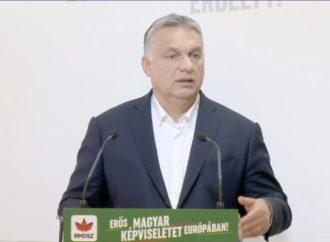
There is quite a bit of meat on the bones of Viktor Orbán’s speech, delivered at the Tusványos “Free University” this morning. I will concentrate on only a couple of topics that I find important.
By way of introduction, I should point out that a great deal of the speech was nothing more than a kind of prophecy, a collection of premonitions about the future of Europe, according to the vision of Viktor Orbán. It is a vision intended to serve the political ambitions of Hungary’s prime minister. I will leave the daydreaming for another post and will instead concentrate on a couple of specifics he outlined for his audience.
First, a few words about the heated discussion on the pages of Magyar Idők regarding liberal versus national literature. In my piece on the subject I wondered whether our two Transylvanian Fidesz loyalists, Sándor Szakács and János Dénes Orbán, began this onslaught against the liberal literary elite on their own or whether they were performing a task they were entrusted with. I always suspected the latter because nothing happens in Orbán’s Hungary without Orbán’s knowledge and/or permission, and in my post I asked “how far the government will take the Kulturkampf.” Well, we now have the answer more or less straight from the horse’s mouth. Orbán made it clear that the creation of a distinct political system is not enough for him; he is thinking in terms of an era, which “is always more than a political order.” Every era has its own specific and characteristic cultural media. Therefore, since a new era is awaiting the country, “it is logical and not at all surprising that the most exciting debate in these days has developed [in Magyar Idők] on cultural policy.” He is not surprisd that this argument between the two sides broke out right after the national election because “indeed, a new intellectual and cultural approach is necessary after the third two-thirds.” The fact is that “great changes are awaiting us from September on.” I hate to think what kinds of new devilish ideas are being hatched to reshape the current cultural landscape.
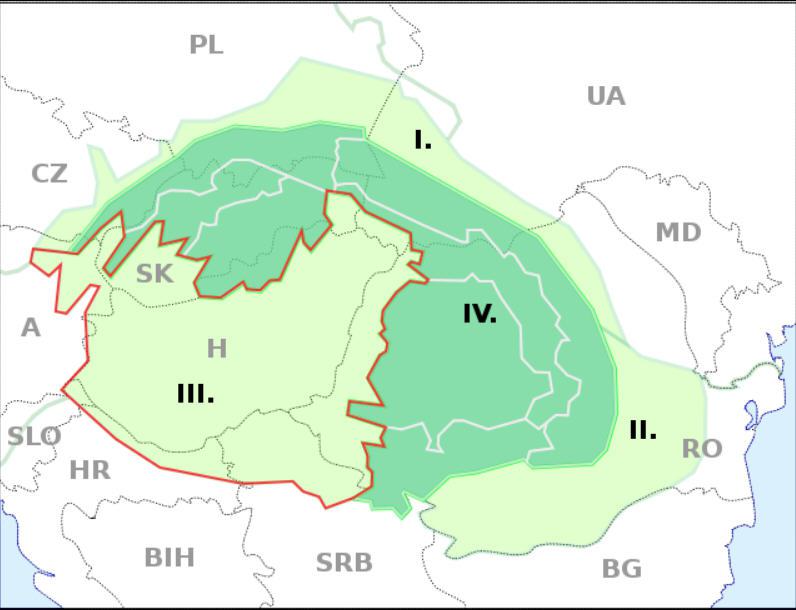
Second, I think that Orbán’s discussion on the future of Central Europe deserves a more serious investigation. He introduced the topic by limiting his vision to the Carpathian Basin, but soon enough he moved on to a grandiose plan of “building a Central Europe which is more spacious and more than the Carpathian Basin.” According to Orbán, the opportunity arrived “to build a large, strong, safe political and economic region, meaning Central Europe.” To Orbán’s mind, this region has such distinctive cultural features that it has to be recognized as a singular entity. Somewhat crudely put, Central Europe must be created and then recognized by the rest of the world.
But what Central Europe is Orbán talking about? It is unlikely that he is thinking of Central Europe as traditionally defined–as an area between Eastern and Western Europe, or more specifically, a region comprised of Austria, the Czech Republic, Germany, Hungary, Liechtenstein, Poland, Slovakia, Slovenia, and Switzerland. Clearly, one cannot find common spiritual or cultural features among these countries. I think that the categories of Oskar Halecki (1891-1973), a distinguished Polish historian and statesman who after World War II became a professor of East European History at Fordham and later Columbia University, are much more helpful. He divided Europe into four regions: Western, West Central, East Central, and Eastern Europe. It is the eastern part of Central Europe, from Finland to Greece, where we must locate Orbán’s imagined Central Europe. In the 1960s, if someone wanted to be precise in describing the Soviet-dominated countries–Poland, Czechoslovakia, Hungary, and Romania, one referred to the region as East-Central Europe. It was a designation that never sat well with Hungarians.
Another categorization came from Paul Robert Magocsi, chairman of Ukrainian Studies at the University of Toronto, who within Halecki’s East Central Europe distinguished three sub-regions: the Northern Zone (Belarus, East Germany, Lithuania, Moldova, Poland, and Ukraine), the Alpine-Carpathian Zone (the Czech Republic, Slovakia, Austria, Hungary, Romania, Slovenia, and Croatia), and the Balkan Zone (Albania, Bosnia and Hercegovina, Bulgaria, Greece, Macedonia, Montenegro, Central Serbia, and European Turkey).
I suspect that Orbán’s Central Europe is a region of his own creation that has nothing to do with either Halecki’s or Magocsi’s categorizations. What he is most likely talking about is the Visegrád 4 countries, which in his mind have singular characteristics–historical, political, and cultural–that distinguish them from both the East and the West. Defined another way, since Orbán would rebuild and reconnect all the territories that formerly belonged to the Kingdom of Hungary within the Carpathian Basin, I suspect that Orbán’s Central Europe would be comprised of the Czech Republic, Poland, and the former Kingdom of Hungary, which would naturally include today’s Slovakia. On this second definition, it would most likely also include parts of Croatia, Romania, Slovenia, Serbia, and Subcarpathian Ukraine. One of the first tasks of a strong, brave, determined Hungary with money and resources is to “rebuild again the Carpathian Basin.” By 2030 he wants to connect “Little Hungary with the other territories,” whatever they are.
I’m certain that Hungary’s neighbors will analyze his words about “rebuilding” the Carpathian Basin very carefully, and I doubt that there will be great enthusiasm for his version of the concept. I’m not optimistic eithre about his success in elevating the Carpathian Basin plus Poland into a unique area of European civilization.
Source: Hungarian Spectrum












Leave a Comment
Your email address will not be published. Required fields are marked with *